6 Hidden Revenue Leaks in Cannabis Retail

Cannabis retailers spend a lot of time thinking about how to bring more customers in: more website traffic, more promotions, more text campaigns, more discounts, more foot traffic, and more first-time shoppers.
All of that has a place. But for many dispensaries, the bigger opportunity may already be sitting inside the shopping experience.
Revenue often leaks long before a customer completes an order.
→ A shopper lands on the menu but cannot quickly find what they want.
→ A customer adds a product to cart, gets distracted, and never returns.
→ A loyalty member has rewards available but does not see them while shopping.
→ A manager has reports from multiple platforms, but no clear view of where customers are dropping off.
→ A budtender answers the same product or ordering questions that a stronger digital experience could have handled earlier.
These moments may not look urgent on their own, but together, they create friction. And in cannabis retail, friction costs money.
The sale is not always lost because of price, product selection, or the dispensary across town. Sometimes, the sale is lost because the digital journey did not make the next step clear enough, fast enough, or easy enough.
Here are six hidden revenue leaks cannabis dispensaries should be watching.
1. The Menu Leak

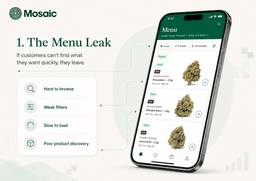
For many dispensaries, the online menu is the first real interaction a customer has with the store.
Before they visit, customers are checking product availability, comparing categories, looking for deals, reading descriptions, and deciding whether the store feels worth their time. The menu is no longer just a product list. It functions as part of the sales floor.
When the menu is difficult to browse, slow to load, hard to filter, or poorly designed for mobile, customers lose momentum. Most will not complain or call the store to ask for help. They will move on.
Cannabis shoppers often need more guidance than they would in other retail categories. They may be comparing strains, formats, potency, pricing, effects, brands, promotions, and purchase limits all at once. If the menu does not help them narrow those choices quickly, the experience starts to feel like work.
A stronger menu experience helps customers understand what is available, find relevant products faster, and move toward checkout with more confidence.
2. The Loyalty Leak

Loyalty programs are often treated as something that happens after a purchase. A customer earns points, gets a reward, receives a message later, and hopefully remembers to use it next time.
That model leaves a lot of value on the table.
Loyalty has more influence when it shows up while the customer is actively shopping. If a customer has points available, they should not have to hunt for them. If they are close to a reward, that information should be visible. If a promotion applies to a category they already buy, the value should be easy to understand before they reach checkout.
When loyalty lives in a separate system or appears too late in the journey, customers may miss the value entirely. A missed reward can become a missed opportunity to strengthen the relationship.
Strong loyalty experiences help customers feel recognized while they are making decisions, which can influence basket size, repeat visits, and long-term retention.
3. The Cart Leak

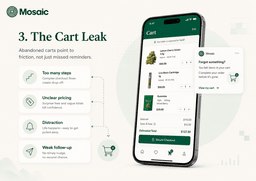
Abandoned carts are one of the clearest signs of revenue leakage because the customer has already shown intent. They found the menu, browsed products, selected something, and got close to ordering.
Then something stopped them.
The reason could be simple distraction, but it can also point to friction in the shopping experience. Maybe checkout had too many steps. Maybe pricing was unclear. Maybe the customer could not find their loyalty reward. Maybe they were not ready to decide. Maybe the mobile experience made the process feel harder than it needed to be.
Many retailers treat abandoned carts as a reminder problem: send a follow-up, offer a discount, and hope the customer comes back. Those tactics can help, but they do not answer the more useful question: why did the customer leave?
Every abandoned cart leaves a clue. It can show where the experience slows down, where shoppers hesitate, and where better customer touchpoints could turn interest into completed orders.
4. The Data Leak


Most cannabis retailers do not have a data shortage. They have POS reports, online ordering activity, loyalty behavior, inventory data, sales trends, and customer engagement metrics.
The challenge is that information often lives across different platforms, making it harder to turn data into action.
Reporting can tell a dispensary what happened, but operators also need to understand what the information means and where to act next. Which products drive repeat purchases? Which promotions bring customers back? Where are shoppers dropping off? Which customers are showing intent but not completing orders? Which categories are building larger baskets?
When data is disconnected, opportunities stay hidden. The business may technically have the information, but the team cannot use it quickly enough to improve the customer experience or recover lost revenue.
5. The Tech Stack Leak
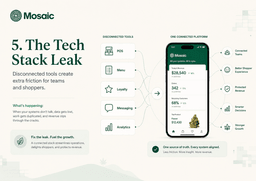
Most fragmented tech stacks are built one reasonable decision at a time.
A POS system is chosen for compliance. An online menu is added because customers expect it. A loyalty tool is introduced to encourage repeat visits. A messaging platform is layered on for marketing. A reporting dashboard is added to make sense of performance.
Each tool may solve a real problem, but over time, the operation can become harder to manage. Staff move between systems, managers pull reports from multiple places, customer data gets trapped, loyalty does not always connect cleanly to ordering, and marketing touchpoints are not always tied to actual shopping behavior.
The customer may not know what is happening behind the scenes, but they feel the result. The experience becomes less seamless, the store becomes harder to shop, and follow-up can feel less relevant.
Fragmented software quietly turns internal inefficiency into customer-facing friction. Over time, those gaps can affect conversion, loyalty, and the overall ease of shopping with the dispensary.
6. The Mobile Leak
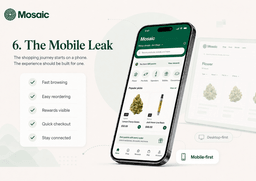
The cannabis shopping journey increasingly starts on a phone.
Customers are searching nearby dispensaries, browsing menus, checking reviews, comparing deals, and deciding where to shop from a mobile device. That means mobile can no longer be treated like a smaller version of desktop.
A mobile experience needs to be fast, intuitive, and designed around how people actually shop. Customers should be able to browse categories quickly, reorder easily, see rewards, check out without unnecessary steps, and stay connected to the store after the first purchase.
When the mobile experience creates friction, dispensaries risk losing customers at the exact moment they are ready to buy.
How Dispensaries Can Find and Fix These Revenue Leaks
The good news is that these six revenue leaks are fixable.
Dispensaries can start by looking at the customer journey more closely. Where do shoppers slow down? Where do they leave? Where does the team rely on manual workarounds? Where are loyalty, ordering, and customer data disconnected? Where does the mobile experience feel harder than it should?
Cannabis retailers are operating in a market where customer expectations are rising, competition is sharper, and margins are under pressure. More traffic will always have value, but traffic alone cannot make up for a leaky shopping experience.
The dispensaries that win will be the ones that make it easier for customers to browse, buy, return, and build a relationship with the store.
Mosaic helps dispensaries bring online ordering, loyalty, customer data, mobile engagement, and smarter touchpoints into one connected digital experience.
The best revenue opportunities are not always hiding in a new campaign. Sometimes, they are hiding in the friction your customers already experience.
Book a demo with our team here: https://mosaic.green/book-a-demo/


